
We can compile a list of fat loss cheat codes:
- First, don’t eat anything. Duh.
- Second, eat mostly Mother Nature’s food.
- Third, drink mostly water and other zero calorie beverages.
- Fourth, eat lean proteins.
- Fifth, eat non-starchy carbohydrates.
You can lose fat using these cheat codes, but you’ll probably reach a bottleneck. Us humans are largely mindless eaters. You’re likely to (unconsciously) balance the scale, in some way or another.
For example, you eat a ton of lean proteins and non-starchy carbs on Monday. Because, cheat code. On Tuesday, however, you eat more than you normally would. You don’t consciously eat more, so you don’t think you eat more. But you do.
At some point, you’ll probably need to keep an eye on everything you put into your body. There are less intense ways to do this, and more intense ways to do this. I’m going to start with a less intense “human” tracking system.
Before I get into this “human” tracking system, we have to figure out how much you should be eating, which is to say: you have to calculate your calorie and macronutrient numbers, given your goal. I have a spreadsheet that’ll do this math for you, but you’re better off knowing how everything comes together.
Even though the ultimate goal is fat loss, I’m going to start by establishing a maintenance food intake, just to help teach the “human” tracking system. We will parlay everything into calorie deficits for fat loss next lesson.
Eating at maintenance means trying to match your income with your expenses. As mentioned, you can estimate how much energy your body uses on a daily basis with the following equation:
BWx13-15
I’m going to use BWx14, but if you’re super sedentary use BWx13, or if you’re insanely active use BWx15.
For the most part, eating at maintenance will maintain your current body composition. (Unless you’re undergoing puberty or some wild hormonal event.) Think in terms of finances. Your income matches your expenses. You’re surviving just fine. But you don’t have much wiggle room. Can’t take extravagant trips. Can’t make lavish structural upgrades. You can really only keep things the way they’ve been.
Using myself as an example, I weigh 205 pounds. My maintenance calorie intake is 205×14=2800 calories. This is my calorie ceiling — the number of calories I should strive to eat on a daily basis.
If I were sedentary and I wanted to maintain my weight my sole concern would be eating 2800 calories daily. I wouldn’t really concern myself with what I was eating. From a body composition standpoint, however, you also need to consider nutrients.
We need to delegate total calorie allotment across the three macronutrients, which is a process that starts with protein.
Protein is the only macronutrient that contains nitrogen. A positive nitrogen balance is associated with growth and repair of muscle tissue. A negative nitrogen balance is associated with decay and breakdown of muscle tissue.
The old school recommendation: eat one gram of protein per pound of body weight.
In other words, if you weigh 180 pounds, then you need to eat 180 grams of protein. This recommendation has some wiggle room. Most research says you probably only need 0.7-0.8 grams per pound of body weight. Also, some protein recommendations are calculated using lean body mass, instead of overall body mass.
In other words, if you weigh 200 pounds and you have 10% body fat, then you have 20 pounds of fat mass, and 180 pounds of lean mass. Given this, you should eat 180 grams of protein.
If you’re obese (read: not skinny-fat), then using lean body mass is a decent idea. But, in general, the one gram per pound recommendation is more user friendly, which is why I stick with it. Protein has a ton of other benefits, too, which is why I’m not worried about eating more protein than what’s “necessary.”
Once you know how many grams of protein you should be eating, you can reverse engineer grams into calories. Every gram of protein yields four calories, so if I’m eating 205 grams of protein, I’m going to be eating 820 calories (205×4).
GRAMS OF PROTEIN / 4
ME: 210 GRAMS OF PROTEIN / 4 = 820 CALORIES
Subtracting the protein calories from my calorie ceiling, I end up with 1980 calories (2800-820). This is how many calories I have left over for carbs and fats.
After factoring out the caloric impact of protein, the caloric remainder gets split between carbohydrates and fats.
Both carbs and fats have their share of haters, but neither macronutrient is worth neglecting. Carbs help replenish muscle glycogen stores, which is useful if you’re doing progressive resistance training (you should be). Fats are essential for survival.
An even 50/50 split between carbs and fats is a good starting point. I don’t obsess over the ratio as much as I used to. Instead, I concern myself more with my calorie ceiling. In the example I’m building, this means both carbs and fats get 990 calories (1980/2).
Carbohydrates yield 4 calories per gram. Given I’m allotted 990 calories in carbs, that means I’m able to eat 247 grams (990/4). Fats yield nine calories per gram. This means 990 calories worth of fat equals 110 grams (840/9).
This gives me this:
- 2800 calories per day
- 205g of proteins
- 260g of carbs
- 115g of fats
As mentioned, I have a spreadsheet that’ll do this math for you, but we aren’t quite ready to go there yet.
Note: The important take away, isn’t my numbers, but, rather, the algorithm itself:
- Find calorie ceiling
- Find protein intake (one gram per pound)
- Reverse engineer protein grams to calories
- Subtract protein calories from calorie ceiling
- Divide remainder calories between carbs and fats
Getting your numbers is easy. Turning macros into food, however, is a rather convoluted process. As mentioned, macronutrients aren’t real.
The question(s) from here: how do you take these numbers and turn them into a tangible quantity of real food, and how do you ensure you’re eating x grams of carbs, y grams of fats, and z grams of protein?
Luckily, we can bridge the gap between macronutrients and food by using the categories previously established: lean proteins, chubby proteins, fats, non-starchy carbs, and starchy-sugary carbs.
━
FATS
▼
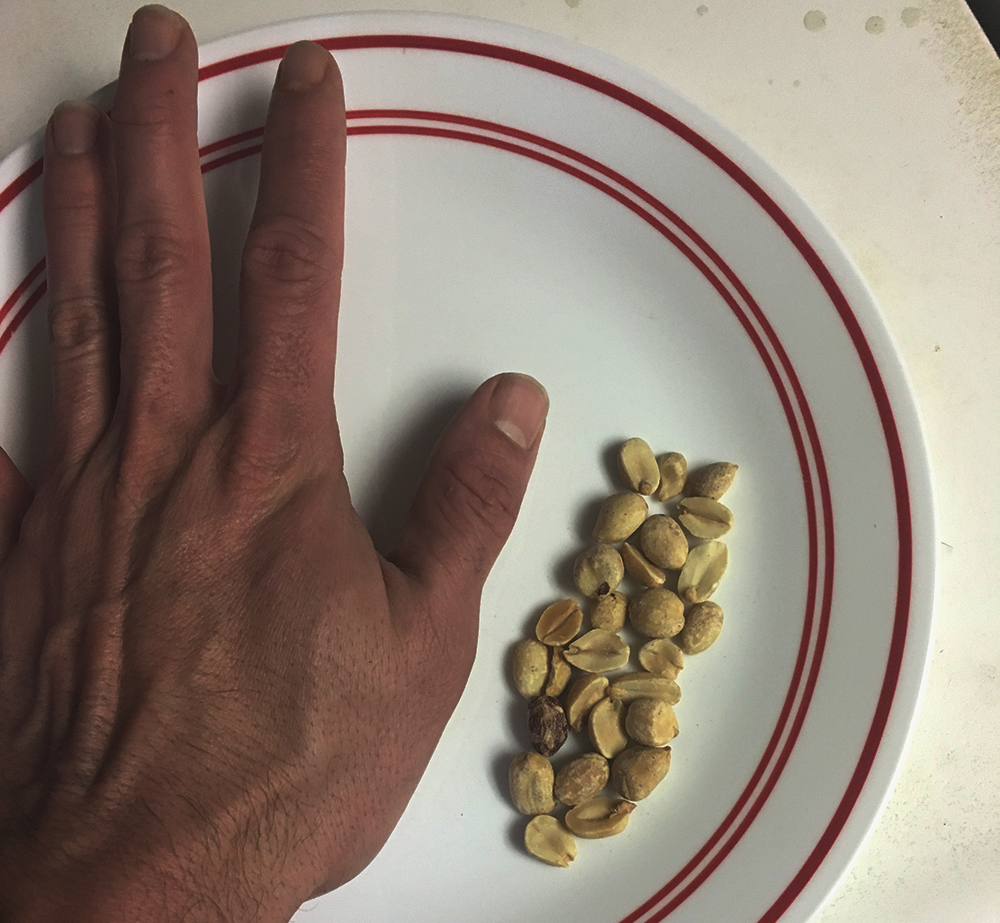
One serving of fats (oils, nuts) is measured in “thumbs.” (For the more liquidy fats, like butter and oil, don’t use depth in your measurement.)
Given that I need 115 grams of fat per day, I will strive to eat 7ish thumbs of fat per day. Unfortunately, not all fats are fats. Some fats are hidden in chubby and purgatory proteins, which can’t go unaccounted for.
The easiest way to account for the fat dancing with protein sources is to break proteins into: lean protein and fat. Let’s start with lean proteins and go from there.
━
LEAN PROTEINS
▼
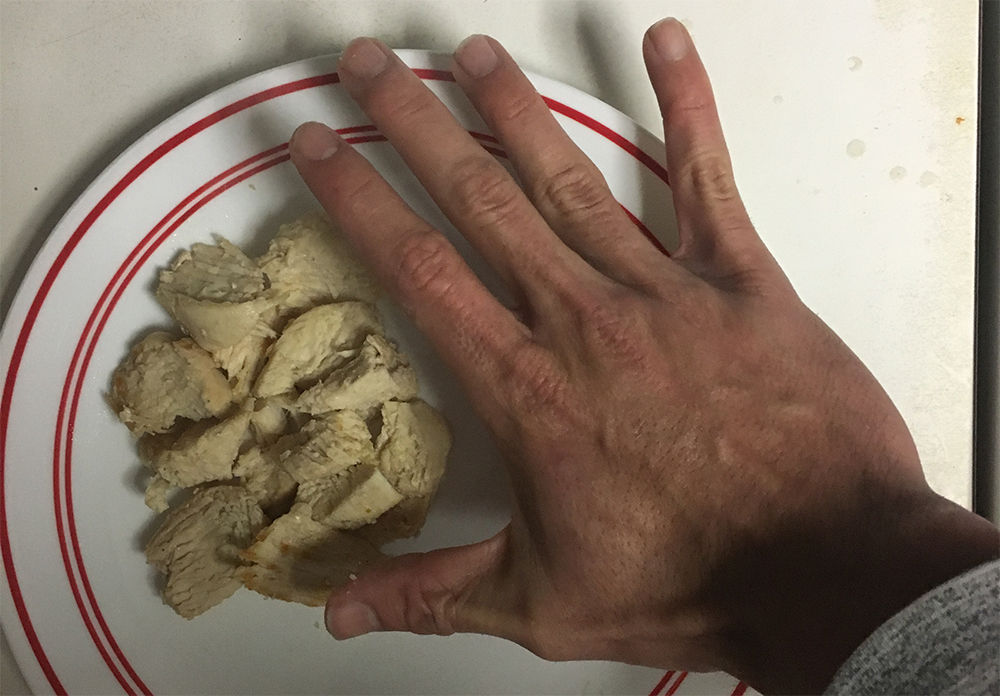
Lean protein servings are measured in “palms.” Sever your hand from your wrist and then cut your fingers off — that’s your lean protein serving.
Given that I need 205g of protein, I will strive to eat 6ish palms of lean protein per day… unless I’m also eating different kinds of proteins.
━
CHUBBY PROTEINS
▼
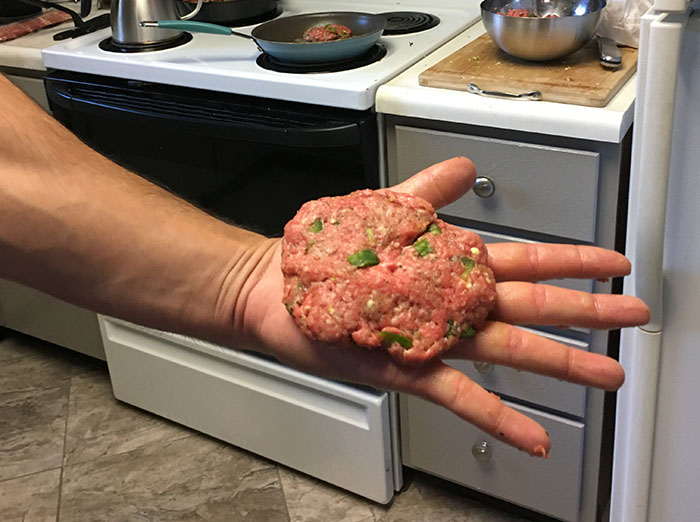
Chubby proteins are also measured in “palms.” I estimate one “palm” of chubby proteins
If I eat one palm of chubby proteins, I’m getting one palm of my daily lean protein allotment and one thumb of my daily fat allotment. Meaning, I’ll have 5ish palms of lean protein remaining, and 6ish thumbs of fat remaining. This is no different than eating 1 palm of chicken breast (lean protein) and 1 thumb of olive oil (fat).
━
PURGATORY PROTEINS
▼
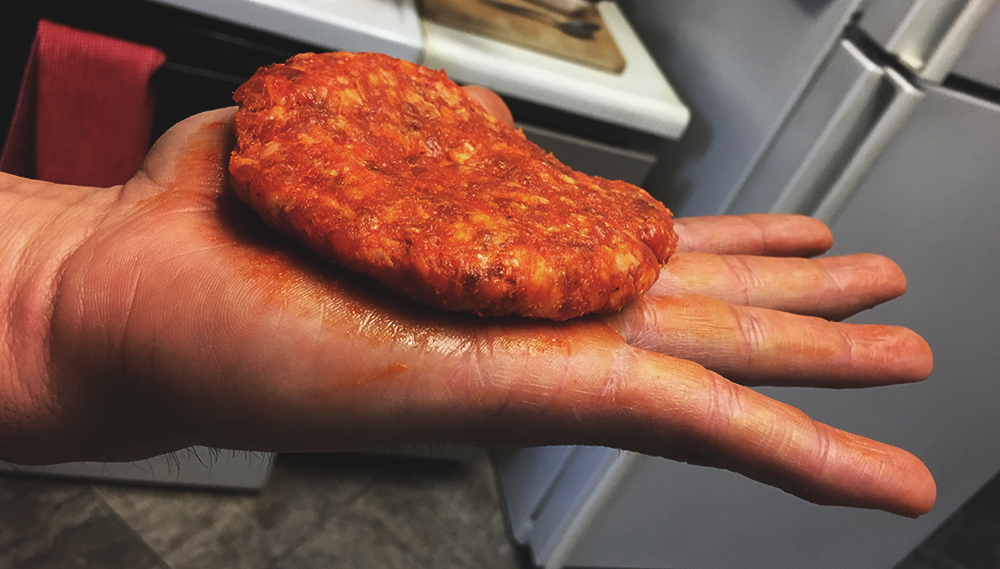
Purgatory proteins are ragamuffins. They’re tough to quantify, because they’re all so different. You’re better off treating purgatory proteins as fats more than proteins. Therefore, purgatory proteins like sausages and (most) cheeses, are measured in “thumbs.”
In other words, one thumb sized portion of a purgatory protein is worth one thumb of fat and trace amount so protein.
━
STARCHY-SUGARY CARBS
▼
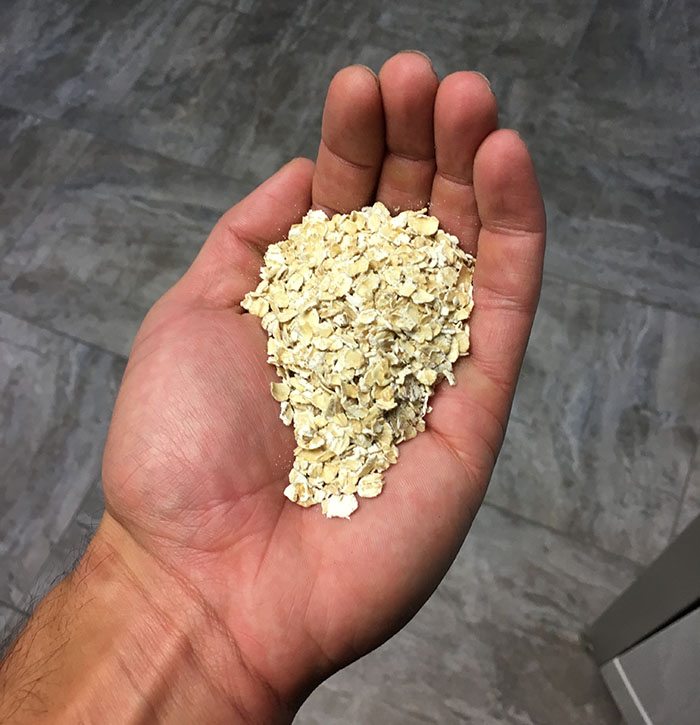
Starchy-sugary carbs are measured in “cupped handfuls.” You can cup most carbohydrate foods, but if you can’t (a potato, or something) think about cubing the food and holding one inch squares.
Given that I need 260 grams of carbohydrates per day, I will strive to eat around 7ish cupped handfuls of starchy-sugary carbs per day… regardless of how many non-starchy carbs I eat.
━
NON-STARCHY CARBS
▼
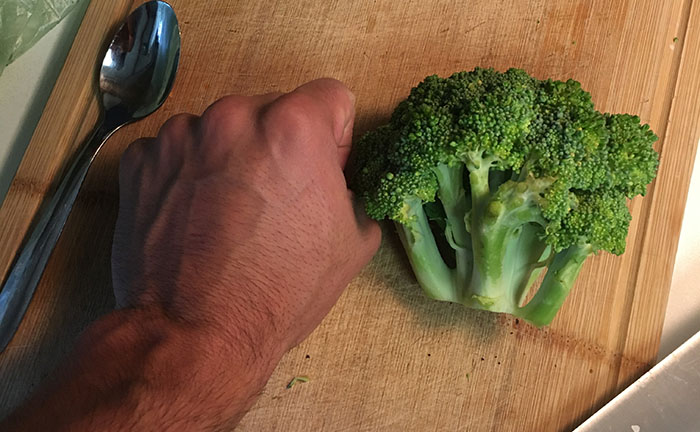
Non-starchy carbs are measured in fists. As you know, non-starchy carbs yield less energy for their volume, which is one of the reasons I don’t include them in the starchy-sugary carb count. They are also chock full of nutrients. I don’t worry about eating too many non-starchy carbs.
As a general recommendation, I strive to eat as many fists of non-starchy carbs as cupped handfuls of starchy-sugary carbs… WITH HALF THE AMOUNT BEING THE MINIMUM. Given I’m striving to eat around 7ish cupped handfuls of starchy-sugary carbs per day, I should eat 3-4 fists of non-starchy carbs, MINIMUM.
━
THE AFTERMATH
▼
First, the spreadsheet.
I created a spreadsheet that calculates calories, macros, and “human” servings, given my algorithm(s). You put in your bodyweight, it’ll spit out grams, palms, fists, and everything else you need to know. Remember, if you’re eating chubby proteins or purgatory proteins, you have to reverse engineer them into lean proteins and fats.
Second, accuracy.
This human portion size system is one giant estimate of one giant estimation. It’s an orgy of estimations, just to ease the burden of beginning. “Eat 6 palms of protein per day” tastes better to my brain than “eat 205 grams of protein per day.”
If you use this system and your results aren’t on par with your expectations, then you will have to troubleshoot your progress. More on this later. For now, we march onward and apply this “human” tracking system to a fat loss framework.